Category: Gym Payments & Renewals

  • WhatsApp Renewal Reminders for Gyms: 8 Templates That Get Members to Pay

    WhatsApp Renewal Reminders for Gyms: 8 Templates That Get Members to Pay

    Quick answer: Send a gym membership renewal reminder on WhatsApp four times: 7 days before the plan ends, on the due date, 3 days after, and 14 days after. Keep every message short, use the member’s first name, state the plan and end date, and include one payment link. The eight templates below are ready to copy.

    Why WhatsApp works for gym renewals

    Most members already have WhatsApp open all day, so a message there is seen faster than an SMS or a call that goes unanswered. It also lets them pay in a couple of taps. In many gyms a good share of lapsed renewals comes from simple forgetting rather than a decision to leave, which is why a timely nudge matters. If your front desk still chases renewals by hand, read The Real Cost of Chasing Membership Renewals By Hand first.

    The 4-message reminder schedule
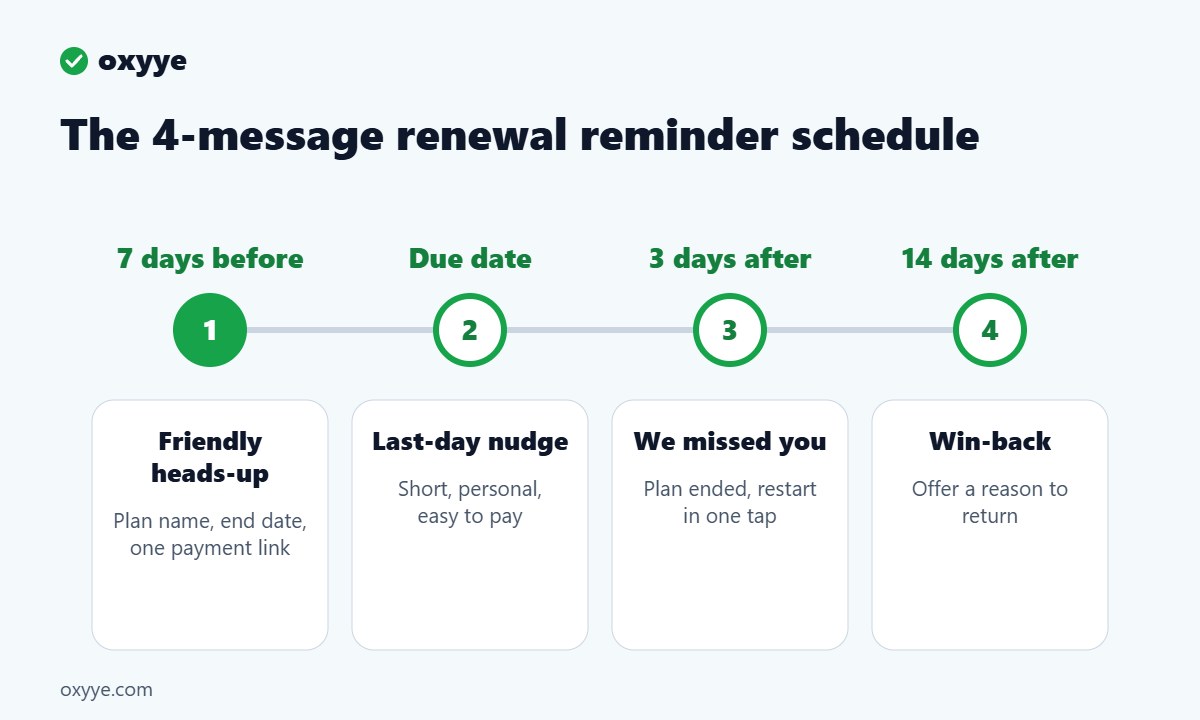
    Infographic: four-message gym renewal reminder schedule, 7 days before, on the due date, 3 days after and 14 days after expiry

    Each message has one job. The first two protect the renewal, the last two win back members who slipped.

    1. 7 days before: a friendly heads-up with the plan name and end date.
    2. On the due date: a short last-day nudge.
    3. 3 days after: a “we missed you” message that makes restarting easy.
    4. 14 days after: a win-back message with a reason to return.

    8 WhatsApp renewal reminder templates for gyms

    Replace the items in curly brackets: {Name}, {Gym}, {Plan}, {Date} and {Link}.

    1. Seven days before expiry

    Hi {Name}, your {Plan} at {Gym} ends on {Date}. You can renew in under a minute here: {Link}. Thank you for training with us!

    2. On the due date

    Hi {Name}, today is the last day of your {Plan}. Renew now and keep your routine going: {Link}

    3. Three days after expiry

    Hi {Name}, we missed you this week. Your {Plan} has ended, and you can restart anytime here: {Link}. Your spot is waiting.

    4. Fourteen-day win-back

    Hi {Name}, we have a fresh week of classes planned and would love to see you back. Reply YES and we will help you restart today.

    5. Warm tone for regulars

    Hi {Name}, you have been one of our most consistent members. Your {Plan} ends on {Date}. Renew here and keep the streak alive: {Link}

    6. Payment not received

    Hi {Name}, we could not see your payment for {Plan} yet. If you have already paid, please reply with a screenshot and we will update it right away. If not, you can pay here: {Link}

    7. Offer a freeze (if your gym allows it)

    Hi {Name}, if you will be away soon, you can freeze your plan instead of letting it lapse. Reply FREEZE and we will help you set it up.

    8. Referral nudge after renewal

    Thanks for renewing, {Name}! Bring a friend for a trial session this month. Just reply with their name and we will set it up.

    What makes a reminder work
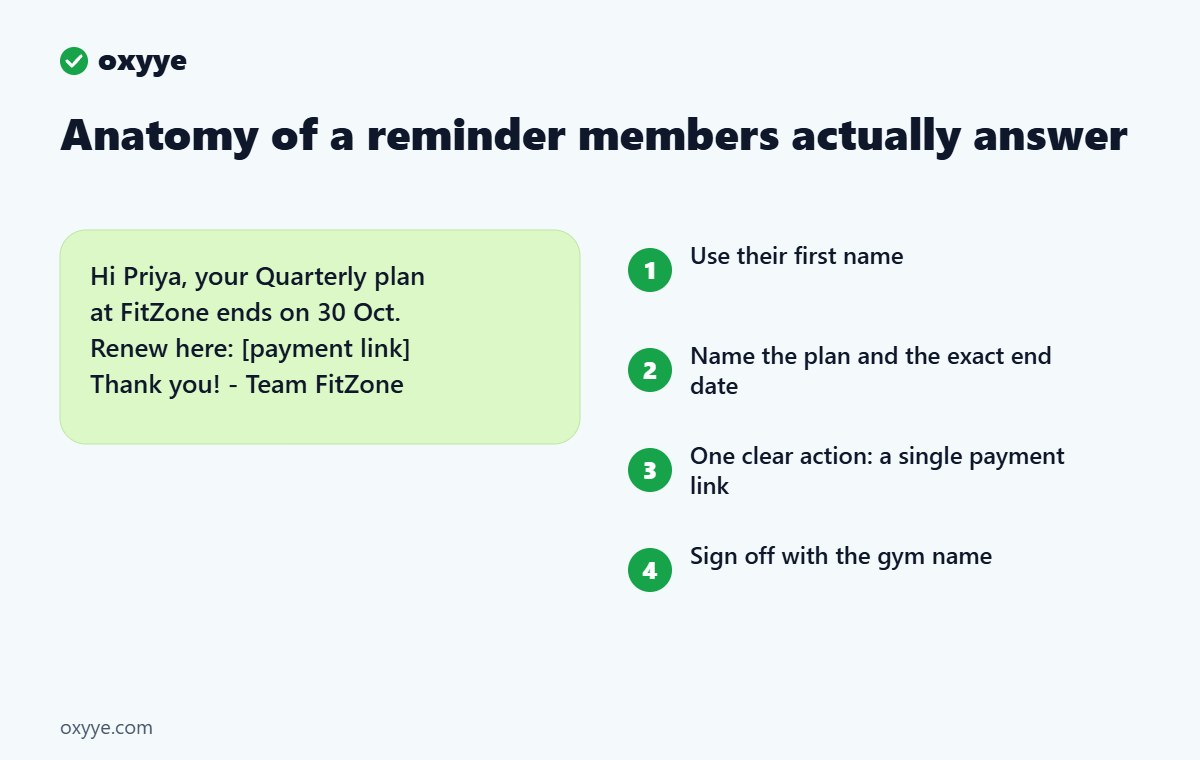
    Infographic: anatomy of a WhatsApp renewal reminder with first name, plan and end date, one payment link and gym sign-off
    • Use the first name. It reads like a person wrote it.
    • Give the exact date. “Ends on 30 Oct” beats “ends soon”.
    • Offer one action. A single payment link, not three options.
    • Keep it short. Under 40 words, no all-caps, one message a day at most.
    • Sign off as the gym. Members should recognise the sender instantly.

    Do’s and don’ts

    • Do get members’ permission to message them on WhatsApp and follow the WhatsApp Business messaging policy.
    • Do send at sensible hours, not late at night.
    • Don’t blast a long list from a personal number. It can get reported or blocked.
    • Don’t send the same message to everyone. A new member and a three-year member need different words.

    Send these without chasing members by hand

    Sending reminders manually means someone must check expiry dates every morning and copy messages one by one. Oxyye sends automated renewal reminders from your member list, so nobody has to remember. See what that looked like for a real gym in How Iron Park Recovered ₹40,000 in Missed Renewals, or compare the options in Oxyye vs Excel and WhatsApp.

    Want reminders that run on their own? Book a 20-minute demo or start a free trial.

    Frequently asked questions

    How early should I remind gym members to renew?

    Seven days before expiry works well for most gyms, followed by a second message on the due date. For monthly plans, three days before is usually enough.

    Can I send renewal reminders from my personal WhatsApp number?

    It is better to use a business number or a tool that sends on your behalf. Sending many messages from a personal number can get it reported or blocked.

    What if members ignore the reminders?

    Follow up 3 and 14 days after expiry with a different message, and call high-value members once. If many members lapse without replying, look at the experience, not just the message. Our guide to cutting gym member churn covers the early warning signs.
  • UPI AutoPay for Gyms: How Automatic Membership Renewals Actually Work

    UPI AutoPay for Gyms: How Automatic Membership Renewals Actually Work

    Quick answer: A UPI AutoPay mandate is standing permission from a member to debit their bank account on a schedule. For gyms, debits up to ₹15,000 go through without the member entering a UPI PIN, you must send a pre-debit notification at least 24 hours before every charge, and a failed payment can be retried up to three times. Get those three things right and renewals stop being a monthly chase.

    Most gym owners in India have heard of UPI AutoPay and assume it works like a card on file. It doesn’t. It’s a mandate system with its own rules about limits, notifications and retries — and the gyms that collect reliably are the ones that understand those rules rather than fighting them.

    The scale is worth noting: UPI AutoPay mandates crossed 1.27 billion in November 2025, growing roughly tenfold in under two years. This is now the default way recurring payments get collected in India, and members are used to it.

    What a UPI AutoPay mandate actually is

    When a member sets up AutoPay, they aren’t handing you their bank details. They’re approving a mandate — a stored instruction with a maximum amount, a frequency and an end date — inside their own UPI app. Your payment provider then presents debits against that mandate on the schedule you set.

    Two consequences follow from this, and both are good for a gym:

    • Nothing expires. Card mandates break when a card is replaced, reissued or hits its credit limit. A UPI mandate is tied to a bank account, so it keeps working.
    • The member stays in control. They can pause, modify or revoke the mandate at any time from their UPI app, without calling you. That sounds like a risk. In practice it removes the main reason people refuse autopay in the first place.

    The limits that actually matter for a gym

    This is where most gyms get tripped up. Under the current framework, a UPI AutoPay debit of up to ₹15,000 executes automatically, with no additional authentication from the member. Above that, the member has to approve the debit with their UPI PIN — which means it will not go through silently.

    There is a higher ₹1 lakh threshold, but it applies only to specific categories: insurance premiums, mutual fund SIP contributions and credit card bill payments. Gym memberships are not on that list. ₹15,000 is your practical ceiling for a hands-off debit.

    For almost every monthly and quarterly plan in India, that’s plenty. Where it bites is annual plans. A ₹24,000 annual membership cannot be auto-debited in one go without the member authenticating. Two ways around it:

    • Bill annual plans as monthly debits against a mandate with an annual commitment. Cleaner cash flow for you, smaller cheque for them.
    • Collect large upfront payments as a one-time UPI payment and use AutoPay only for what renews. Don’t force a ₹24,000 debit through a mandate and hope.

    The 24-hour rule nobody mentions until it breaks

    Every scheduled debit needs a pre-debit notification sent to the member at least 24 hours in advance, and it has to carry the amount, the date and the mandate reference. This isn’t optional and it isn’t a nicety — it’s part of the framework.

    Gyms that treat this as a compliance checkbox send a bare SMS nobody reads. Gyms that treat it as a retention touchpoint send a WhatsApp message that says what’s being charged, when, and what the member gets for it. Same obligation, very different effect on the number of people who pause the mandate in month four.

    What actually happens when a payment fails

    Failures are normal. Insufficient balance on the 1st of the month is the most common one in India, and it says nothing about whether the member wants to keep training.

    The current framework allows one original attempt plus a maximum of three retries. That’s the whole recovery window. Used well, it covers the gap between a member’s salary date and your billing date, and most “failed” payments simply land on the second or third attempt.

    Used badly — which usually means nobody has configured retries at all — the payment fails once, nothing happens, and three weeks later somebody notices the member is unpaid. That gap is where the money goes. We put numbers on it in the real cost of chasing membership renewals by hand, and a Bengaluru gym recovered ₹40,000 in a single month mostly by closing it.

    UPI AutoPay vs card mandates, for an Indian gym

    Card mandates still have a place, particularly for members who prefer credit cards or for international clients. But for a typical Indian gym, UPI AutoPay wins on the metric that matters — how often the money actually arrives:

    • No expiry churn. Card reissues silently kill mandates. Bank accounts don’t get reissued.
    • No credit limit problem. A card mandate fails when the member is near their limit even though they have money.
    • Setup happens where the member already is. Approving a mandate in PhonePe, Google Pay or Paytm takes seconds and needs no card details typed into anything.

    The practical answer for most gyms is to offer both and default to UPI AutoPay.

    Setting it up without annoying anyone

    1. Set the mandate cap above the plan price. If a member is on ₹2,000/month, set the mandate ceiling with headroom so a price change later doesn’t require a new mandate.
    2. Align the debit date with salary dates. The 1st is the worst day of the month to bill in India. The 5th or 7th fails far less often.
    3. Send the pre-debit notice on WhatsApp, not SMS. It’s the channel your members actually open, and it doubles as a renewal reminder.
    4. Configure all three retries. Spread them across a few days rather than firing them in one afternoon.
    5. Have a human step for the ones that still fail. After three failed retries, someone should know within a day, not a month.

    If your current setup is a payment link sent manually each month and a spreadsheet to track who paid, you’re carrying all five of these steps by hand. That’s one of the five signs a gym has outgrown spreadsheets and WhatsApp.

    Frequently asked questions

    Is UPI AutoPay safe for members?

    The member approves the mandate in their own banking or UPI app and can revoke it there at any time. You never hold their account credentials. It is materially safer than a card number written in a register at the front desk, which is still how a surprising number of gyms operate.

    What is the maximum a gym can auto-debit without the member approving it?

    ₹15,000 per debit. The higher ₹1 lakh limit is restricted to insurance premiums, mutual fund SIPs and credit card bills, and does not cover gym or studio memberships.

    How many times can a failed gym payment be retried?

    One original attempt plus up to three retries. After that the debit has to be re-presented as a fresh collection, which in practice means someone has to follow up with the member.

    Do I still need to send reminders if payments are automatic?

    Yes — a pre-debit notification at least 24 hours before each charge is required, and it must state the amount, date and mandate reference. Most gyms fold that requirement into their renewal reminder so members get one clear message rather than two.

    Stop chasing, start collecting

    Oxyye runs UPI AutoPay and card mandates through Razorpay, sends the pre-debit notifications on WhatsApp, retries failed payments automatically and flags the ones that still don’t clear. Try it on your own member list for 14 days — no card required.

    Related reading

  • The Real Cost of Chasing Membership Renewals By Hand

    The Real Cost of Chasing Membership Renewals By Hand

    Quick answer: Manual renewal follow-ups leak gym revenue through late reminders, missed follow-ups, and failed payments that never get retried. Automating reminders and retries — the approach Iron Park in Bengaluru used to recover ₹40,000 in missed renewals in a single month — closes that gap without adding headcount. India’s UPI AutoPay ecosystem, which crossed 1.27 billion mandates by November 2025, makes reliable automated retries standard infrastructure for any recurring-revenue business — gyms included.

    Every gym owner has had this month: revenue looks fine on paper, but cash in the bank tells a different story. Somewhere between “renewal due” and “renewal collected,” money went missing — not stolen, just never followed up on.

    That gap has a name: manual renewal leakage. And it’s one of the most expensive problems in gym management, precisely because it doesn’t show up as a single big loss. It shows up as fifty small ones.

    Where the money actually goes

    1. The reminder that never got sent. A membership lapses quietly on the 14th. Nobody notices until the member has already stopped showing up — and by then, winning them back costs far more than reminding them on time would have.

    2. The follow-up that happened too late. Your front desk is juggling check-ins, new leads, and a WhatsApp group that never stops buzzing. Renewal calls get pushed to “later.” Later becomes never. (This is often the same underlying problem covered in 5 Signs Your Gym Is Still Running on Spreadsheets and WhatsApp.)

    3. The payment that failed silently. A card declines or a UPI mandate doesn’t go through, and unless someone is actively watching, that failed payment just sits there — no retry, no reminder, no revenue.

    None of these are failures of effort. They’re what happens when a growing gym runs renewals through memory, spreadsheets, and goodwill instead of a system built for it.

    What “automated” renewals actually means

    Automating renewals isn’t about removing the human touch — it’s about making sure the right message reaches the right member at the right time, every time, without depending on someone remembering to send it.

    That looks like: reminders that go out automatically before a membership lapses, payments that retry on their own when a card or UPI Autopay charge fails, and an at-a-glance view of exactly who’s overdue and how much revenue is sitting at risk — before it becomes a cancelled membership.

    What changes when you stop chasing

    Gyms that move renewals off spreadsheets and WhatsApp typically see two things shift fast: fewer memberships lapse without a follow-up, and the person who used to spend hours a week chasing payments gets that time back for the floor.

    Recovering a member who nearly lapsed is also far cheaper than acquiring a new one. The reminder you send on day one of a renewal window is worth more than the win-back campaign you run three months later.

    If your gym is still tracking renewals in a notebook, a spreadsheet, or a WhatsApp group tagged “urgent,” the fix isn’t hiring more front desk staff — it’s letting the system do what it’s already good at, so your team can do what only people can do: keep members coming back.

    Frequently asked questions

    How much revenue do gyms typically lose to missed renewals?
    There’s no single industry-wide figure — it depends on gym size, pricing, and how consistent follow-up already is. But the leakage is real and documented at the individual-gym level: Iron Park in Bengaluru recovered ₹40,000 in missed renewals in its first month after automating reminders and retries (see the full case study).

    What’s the difference between a renewal reminder and a renewal retry?
    A reminder is a message telling a member their membership is about to lapse. A retry is an automatic second (or third) attempt to charge a payment method after it initially fails — no phone call required. Gyms that lose the most revenue usually have neither running consistently.

    Does automating renewals feel impersonal to members?
    Not when it’s done well — a timely, well-worded reminder is more respectful of a member’s time than a surprise cancellation notice or an awkward “did you mean to leave?” call weeks later.

    How is UPI Autopay different from a manual UPI payment for renewals?
    UPI Autopay lets a member authorize a recurring mandate once, after which payments are collected automatically on schedule — similar to a card standing instruction, but built on India’s UPI rails. It’s become the default way recurring payments are collected in India, which is why reliable retry handling on top of it matters so much for subscription businesses like gyms.

    Start your free trial and see how many renewals are already sitting at risk in your gym — no card required.

    Related reading