Tag: gym operations

  • How to Convert Gym Enquiries into Members: A Simple Follow-Up Routine

    How to Convert Gym Enquiries into Members: A Simple Follow-Up Routine

    Quick answer: To convert gym enquiries into members, reply within the hour, book a specific trial slot, make the first visit count, and follow up on day 1, day 3 and day 7. In many gyms, enquiries go cold because follow-up is inconsistent, not because people were not interested.

    Where gym leads are lost
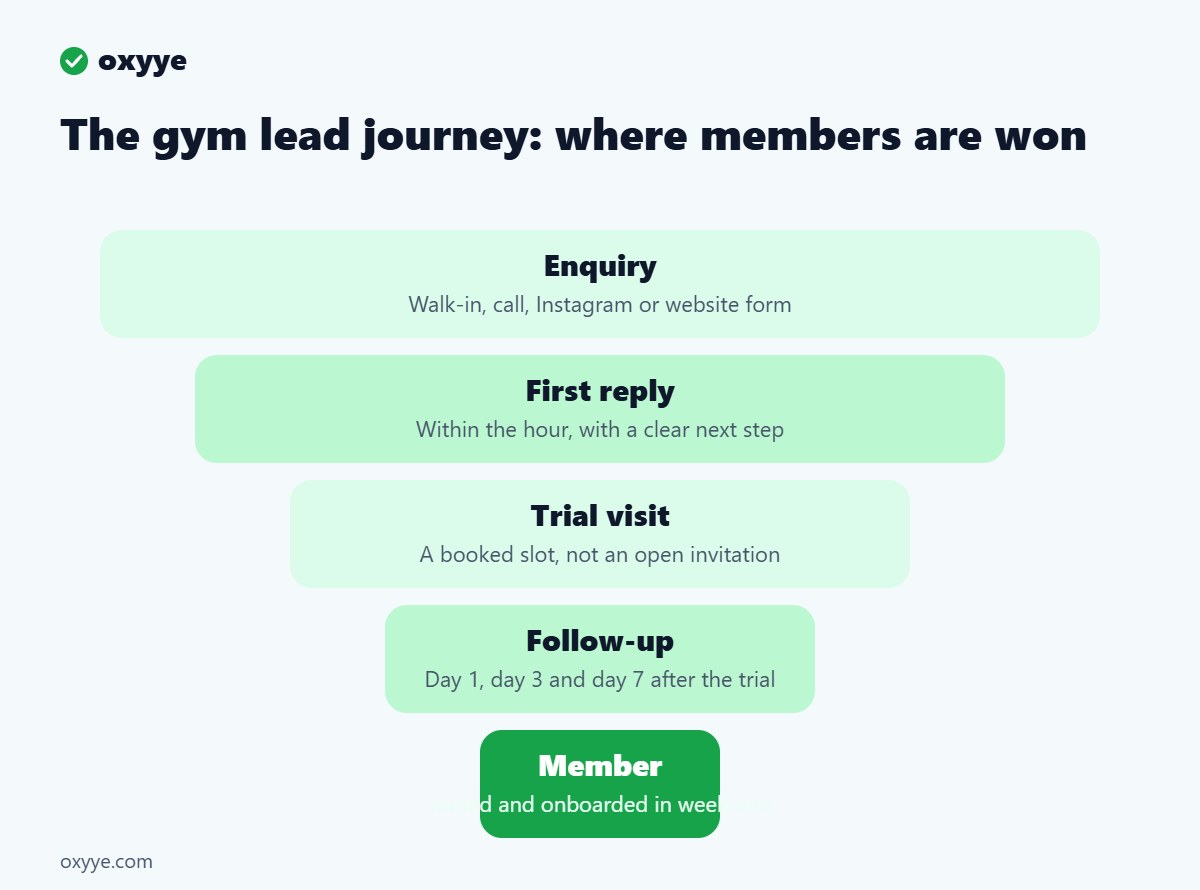
    Infographic: gym lead journey from enquiry to first reply, trial visit, follow-up and joined member

    Most gyms spend effort getting enquiries through Instagram, walk-ins and calls, then lose many of them in the days that follow. The routine below fixes the leaks in order.

    Step 1: Reply fast, with a next step

    Reply as soon as you can, ideally within the hour. Thank them, answer their question, and offer a specific trial time. Do not end with “let us know”. End with a choice: “Would 6 pm today or 7 am tomorrow suit you?”

    Step 2: Book a trial slot, not a vague invite

    “Come by anytime” rarely turns into a visit. A booked slot gives the lead a reason to show up and gives you a number to track.

    Step 3: Make the first visit count

    • Greet them by name and give a short walkthrough.
    • Ask one goal question: “What do you want to achieve in three months?”
    • Let them try a session, with no pressure to pay on the spot.
    • Agree on the next step before they leave.

    Step 4: Follow up on day 1, day 3 and day 7
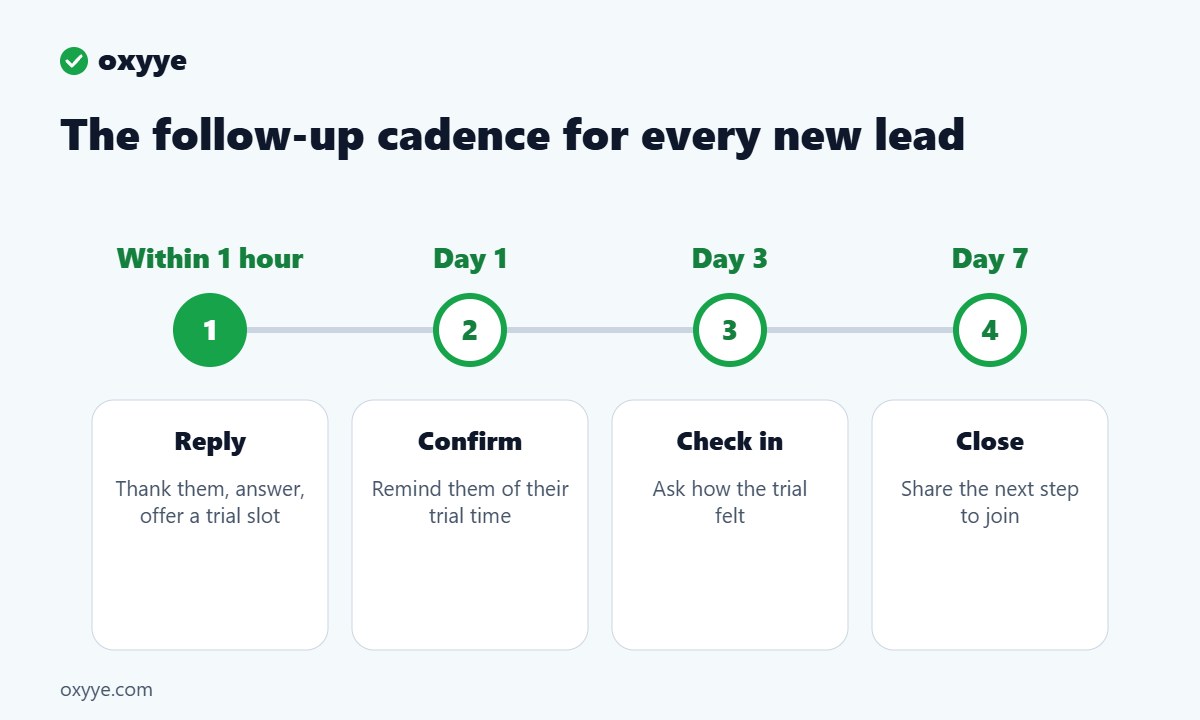
    Infographic: follow-up cadence for new gym leads within 1 hour, day 1, day 3 and day 7

    First reply

    Hi {Name}, thanks for asking about {Gym}! We would love to have you try a session. Would {Time 1} or {Time 2} suit you?

    Trial confirmation (day before)

    Hi {Name}, a reminder that your trial at {Gym} is tomorrow at {Time}. Wear something comfortable. We will meet you at the front desk.

    Day 3 check-in

    Hi {Name}, how did your trial feel? If you have any questions about plans or timings, reply here and I will help.

    Day 7 close

    Hi {Name}, we would love to have you join {Gym}. Reply YES and I will share the next step to get started.

    These work best as WhatsApp messages. For more wording ideas, see our WhatsApp reminder templates for gyms.

    Step 5: Keep every enquiry in one place

    Sticky notes and memory lose leads. Write down, for every enquiry: name, how they found you, trial date and the next follow-up date. If you are doing this in a notebook or a spreadsheet, see how it compares in Oxyye vs Excel and WhatsApp.

    Mistakes that cost you members

    • Offering a discount in the first message, before they have seen the gym.
    • Following up once and stopping.
    • Sending the same message to everyone.
    • Ignoring Instagram and WhatsApp messages sent after hours.

    After they join, the first 30 days decide the renewal

    Winning the member is half the job. Keeping them is the other half. Welcome them in week one, check attendance, and set up renewal reminders from day one. Our guide to cutting gym member churn shows the early warning signs. Oxyye keeps member records and automated renewal reminders in one place, so the members you win stay.

    Want to keep the members you win? Book a 20-minute demo or start a free trial.

    Frequently asked questions

    How fast should a gym reply to a new enquiry?

    As fast as you can, ideally within the hour. A quick reply keeps the lead warm while they are still comparing gyms.

    How many times should I follow up with a gym lead?

    At least three times over a week: before the trial, after it, and a final nudge on day 7. Stop when the lead says no or joins.

    Should I offer a free trial?

    A short trial or pass works well for many gyms because members experience the gym before they decide. Keep it to a booked slot, so you can measure how many trials turn into members.

  • How to Choose Gym Management Software in India: A 6-Point Checklist

    How to Choose Gym Management Software in India: A 6-Point Checklist

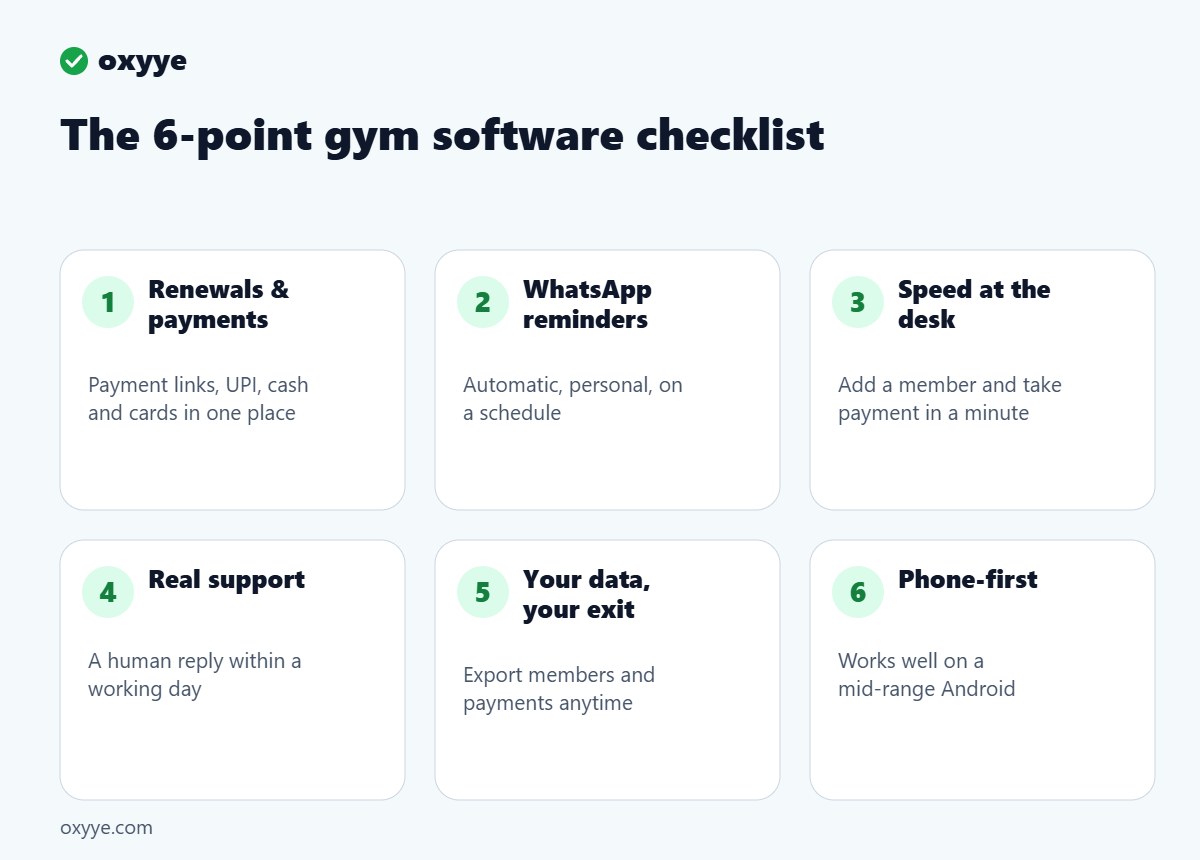
    Quick answer: Choose gym management software by testing six things during a trial: how it handles renewals and payments, WhatsApp reminders, speed at the front desk, support, your data export, and how it works on a phone. Run the trial with your real members for 7 days before you commit.

    When a register or Excel sheet stops working

    A paper register or spreadsheet works while you have a handful of members. The cracks show when you cannot say, without searching, who is due this week, who paid by UPI and who paid cash. If that sounds familiar, read 5 Signs Your Gym Is Still Running on Spreadsheets and WhatsApp. If you want the side-by-side view, see Oxyye vs Excel and WhatsApp.

    The 6-point gym software checklist

    Infographic: 6-point checklist for choosing gym management software in India

    1. Renewals and payments

    Your biggest daily job is collecting renewals. Test it: add a member, set an expiry date, generate a payment link, and record one cash payment. Everything should land in one place.

    2. WhatsApp reminders

    Members respond to WhatsApp. Test it: send a real reminder to your own number. Check the wording is editable and that it goes out automatically on a schedule. Our WhatsApp reminder templates give you wording to start with.

    3. Speed at the front desk

    Slow software gets abandoned. Test it: time yourself adding a new member and taking a payment. If it takes more than a couple of minutes, your desk staff will stop using it.

    4. Support you can reach

    You will have questions in week one. Test it: ask one real question during the trial and note how long a human takes to reply, and in which language.

    5. Your data and your exit

    Your member list is your business. Test it: export members and payments to Excel. If you cannot, treat that as a warning sign.

    6. Phone-first design

    Most gym owners and staff work from a phone. Test it: run the whole trial on the phone your staff actually use, not a new laptop.

    Red flags to watch for

    • You cannot try it with your own member data.
    • You cannot reach a person before you buy.
    • A feature you depend on is “coming soon”. Ask what works today versus what is planned.
    • There is no way to export your data.
    • The demo only ever uses dummy members.

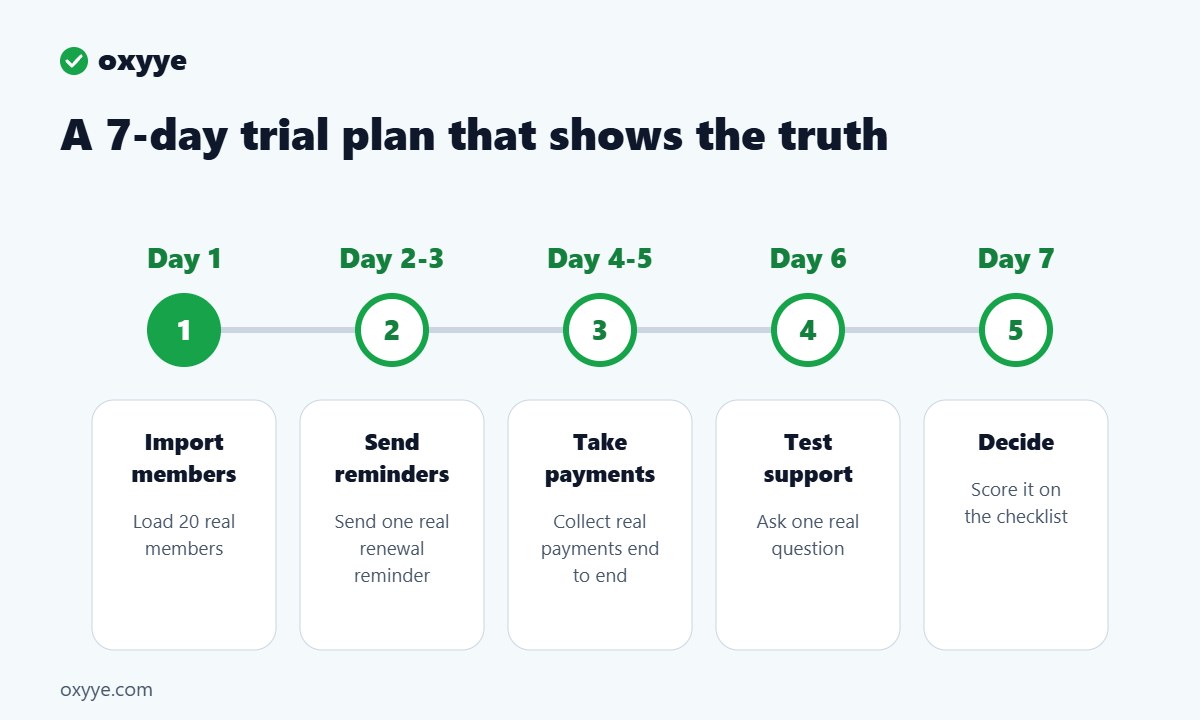
    A 7-day trial plan that shows the truth

    Infographic: 7-day trial plan for testing gym management software with real members and payments
    1. Day 1: import about 20 real members.
    2. Days 2 to 3: send one real renewal reminder.
    3. Days 4 to 5: collect real payments from start to finish.
    4. Day 6: ask support a real question.
    5. Day 7: score the software against the six points above and decide.

    Where Oxyye fits

    Oxyye is gym management software built for gym owners in India. It keeps member records and payments in one place and sends automated renewal reminders, so your team spends less time chasing renewals. You can see how it works on the features page and read how Iron Park recovered ₹40,000 in missed renewals.

    Ready to run the 7-day test? Book a 20-minute demo or start a free trial.

    Frequently asked questions

    What should gym management software do?

    At minimum: store member records, track plans and expiry dates, take payments, and remind members to renew. Good software also lets you export your data and works smoothly on a phone.

    Do I need gym software if I run a small gym?

    If you are missing follow-ups, losing track of who has paid, or spending your evenings updating a sheet, software will likely save time. Small gyms often feel the pain of manual renewals first.

    How long should I trial gym software?

    Seven days with real members is enough to test payments, reminders and support. A demo with dummy data does not show how the software behaves in your gym.

    Can I move my data to another tool later?

    You should be able to. Ask for a member and payment export before you start, and test it during the trial.

  • How to Cut Gym Member Churn: The Signals That Predict a Cancellation

    How to Cut Gym Member Churn: The Signals That Predict a Cancellation

    Quick answer: The industry averages roughly 66% annual retention, which means a third of your members leave every year. Most of that churn is predictable weeks in advance, because attendance falls before anyone cancels. A member checking in 12+ times a month has about a 2% chance of cancelling next month; one down to a single check-in is closer to 20%. Watching that number is the cheapest retention work available to you.

    Gym owners tend to treat churn as weather — something that happens to you. It isn’t. It’s a measurable rate with published benchmarks, a direct multiplier on the value of every member you sign, and a set of warning signs that show up in your own attendance data before a member ever says the word “cancel”.

    What “normal” churn actually looks like

    The HFA 2025 Fitness Industry Benchmarking Report puts average annual retention at 66.4%. Boutique studios generally aim higher, in the 75–80% range.

    Monthly churn is the more useful number day to day. Rough benchmarks:

    • Under 3% — elite. Usually small, community-driven gyms with strong onboarding.
    • 3–4% — strong. A healthy, well-run operation.
    • Under 5% — acceptable. Nothing alarming.
    • 5–6% and above — needs work. You are refilling a leaking bucket.

    Before you can improve it you have to measure it, and this is where most Indian gyms stall: if renewals live in a spreadsheet and payments live in a WhatsApp thread, monthly churn is a number nobody can produce on demand. That’s one of the five signs a gym has outgrown its tools.

    Why one percentage point matters more than you think

    Member lifetime value is simply average monthly revenue per member divided by your monthly churn rate. That division is what makes small changes in churn so violent.

    Take a gym charging ₹2,000 a month:

    • At 6% monthly churn, the average member is worth about ₹33,000.
    • At 3% monthly churn, the same member is worth about ₹67,000.

    Halving churn doubles the value of every single person who walks through the door — without spending a rupee more on marketing. And it compounds the other way too, because it costs roughly five times more to acquire a new member than to keep an existing one.

    Put plainly: an hour spent on retention is worth several hours spent on lead generation, and almost nobody’s calendar reflects that.

    Attendance is the earliest signal you get

    Members rarely announce their departure. They fade. The pattern is consistent enough to be actionable:

    • 12+ check-ins a month — roughly a 2% chance of cancelling next month.
    • 1 check-in a month — roughly a 20% chance. Ten times the risk.

    The important part is the gap. That decline usually plays out over 10 to 14 days before a member formally cancels or lets a renewal lapse. If somebody is watching attendance in real time, that’s a two-week window to intervene while the member is still ambivalent. If nobody is, you find out when the payment doesn’t come through — and by then the decision has already been made.

    This is the single biggest argument for check-in data that updates automatically rather than a register at the front desk. A QR check-in takes the member two seconds and gives you a churn forecast for free.

    Most of your churn happens before month four

    The other consistent finding: most churn happens in the first three months. New members who don’t establish a habit in that window rarely establish one later.

    Which means retention is mostly an onboarding problem wearing a disguise. The gym that assigns a first session, checks in at day 7 and day 30, and notices when a new joiner misses a week will beat the gym with better equipment and no follow-up. Every time.

    A 90-day retention playbook

    1. Day 0 — book the first session before they leave. A membership without a scheduled first visit is a donation with extra steps.
    2. Day 7 — one human message. Not a broadcast. “How did the first week go?” from a name they recognise.
    3. Day 14 — flag anyone with fewer than three visits. This is the earliest point where the habit is visibly not forming.
    4. Day 30 — a short check-in on goals. Members who can articulate what they’re training for stay materially longer.
    5. Day 60–90 — watch for the drop-off. Any member whose weekly frequency halves goes on the at-risk list automatically.
    6. Every month — reconcile attendance against renewals. Anyone who is paying but not showing up is next month’s cancellation.

    None of this is clever. All of it is tedious to do by hand for 200 members, which is exactly why it doesn’t get done.

    What to do about the ones already drifting

    For members already in the at-risk band, three things work better than a discount:

    • Ask, don’t sell. “We’ve missed you this month — is the timing not working?” gets an honest answer. A 20%-off message gets ignored.
    • Offer a schedule change, not a price change. Most fading members have a logistics problem, not a value problem.
    • Use WhatsApp. In India it is read; email and SMS largely are not.

    Discounting a member who was going to stay anyway is the most expensive retention tactic there is. Reach them on attendance data instead of on renewal date and you rarely need to discount at all — which is broadly how one Bengaluru gym recovered ₹40,000 in a single month.

    Frequently asked questions

    What is a good monthly churn rate for a gym?

    Under 5% is acceptable, 3–4% is strong, and under 3% puts you among the best operators. Above 5–6% you are losing members faster than most gyms your size and it will show up in cash flow within two quarters.

    How do I calculate my gym’s churn rate?

    Divide the number of members who left during the month by the number you started the month with, then multiply by 100. Count lapsed renewals as churn, not just formal cancellations — otherwise you will flatter yourself.

    Does attendance tracking really predict cancellations?

    Consistently. The gap between a member at 12+ check-ins a month and one at a single check-in is roughly tenfold in cancellation probability, and the decline typically shows up 10 to 14 days before the cancellation itself.

    Is it cheaper to retain a member or acquire a new one?

    Retention, by a wide margin — acquiring a new member costs roughly five times what keeping an existing one does. It also compounds, because every point of churn you remove multiplies the lifetime value of members you already have.

    See who is drifting, before they go

    Oxyye flags at-risk members from attendance and payment patterns, and sends the nudge on WhatsApp while it still matters. Point it at your existing member list and see how many are already in the risk band.

    Related reading

  • 5 Signs Your Gym Is Still Running on Spreadsheets and WhatsApp

    5 Signs Your Gym Is Still Running on Spreadsheets and WhatsApp

    Quick answer: The clearest sign a gym has outgrown spreadsheets and WhatsApp is that nobody notices a member is at risk until they’ve already stopped coming — attendance data from the fitness industry shows members with 12+ check-ins a month have roughly a 2% chance of cancelling, versus about 20% for members with just one check-in a month (PushPress / HFA Fitness Industry Benchmarking Report). If nobody’s watching that signal in real time, it’s invisible until it’s too late.

    Most gyms don’t choose to run on spreadsheets and WhatsApp groups. It just happens — one workaround at a time, until the workaround is the system. Here’s how to tell you’ve outgrown it.

    1. Your front desk doubles as a debt collector

    If collecting payment means someone physically calling or messaging a member to ask “hey, did you mean to renew?” — that’s not a payment process, that’s a favor you’re asking your team to do, every single month, for every single member. (This is the same root cause behind the real cost of chasing renewals by hand.)

    2. You find out someone quit a month after they stopped coming

    By the time a lapsed membership shows up on your radar, the member has usually already mentally moved on. Industry benchmarking backs this up: members checking in 12+ times a month have roughly a 2% chance of cancelling the next month, while members at just one check-in a month face closer to a 20% chance. That window — 10 to 14 days of declining visits before a member formally cancels — is invisible if nobody’s watching attendance in real time.

    3. Your “system” is three apps and a WhatsApp group

    A booking app for classes. A separate spreadsheet for payments. A WhatsApp group for reminders. Each one works fine on its own — but none of them talk to each other, which means every cross-check is manual, and every mistake is easy to make and hard to catch.

    4. Leads go cold because nobody followed up in time

    A warm lead from Instagram or a walk-in tour is worth the most in the first 24 hours. If enquiries land in a notebook or a phone’s “notes” app instead of a pipeline someone actually works, most of them quietly disappear — not because the gym wasn’t good enough, but because nobody called back in time.

    5. You don’t know your numbers until month-end

    Revenue today, active members, pending collections, renewals due — if the honest answer to “how’s the gym doing right now” is “let me check on Monday,” you’re running the business a week behind reality.

    None of this means you’re doing it wrong

    It means the gym outgrew the tools before the tools caught up. Spreadsheets and WhatsApp groups are what every growing gym starts with — they’re just not built to scale past a certain number of members without something breaking. Gyms that fix this well often see it show up directly in retention — see how Iron Park recovered ₹40,000 in missed renewals once the process stopped relying on memory.

    The fix isn’t more hours or more staff. It’s one dashboard that shows revenue, renewals, attendance, and leads in one place — so the business runs on visibility instead of memory.

    Frequently asked questions

    What’s a healthy gym retention rate to benchmark against?
    The HFA 2025 Fitness Industry Benchmarking Report puts the industry-average annual gym retention rate at 66.4%, measured across 175 companies and more than 17,000 facilities. Elite small-group and boutique operators often run under 3% monthly churn.

    How early can you actually spot a member who’s about to cancel?
    Attendance is the strongest early signal. Members checking in 12+ times a month have roughly a 2% chance of cancelling the next month; at one check-in a month, that risk climbs to around 20%. Watching that gap in real time — not at month-end — is what separates gyms that intervene in time from ones that find out after the fact.

    Do we need to replace everything at once — booking app, spreadsheet, WhatsApp?
    No. The goal is getting member data, payments, attendance, and leads into one place that talks to itself, not ripping out every tool overnight. Most gyms move one workflow at a time, starting with whichever is causing the most missed revenue or missed follow-ups.

    See it running on your numbers — book a 20-minute demo.

    Related reading